
FY28–29 STIF Plan
TriMet wants to know how you feel about our plan to spend Statewide Transportation Improvement Funds in Clackamas, Multnomah and Washington counties in Fiscal Years 2028 & 2029 (July 2028 through June 2029). These funds make up a small portion of TriMet’s overall budget, which is facing a long-term deficit requiring us to reduce service in many areas.
What is the Statewide Transportation Improvement Fund (STIF)?
The Statewide Transportation Improvement Fund (STIF) manages the 0.1% employee payroll tax paid by all Oregon workers that was established by the Oregon Legislature in 2017. The money raised by this tax helps improve, expand and maintain public transportation across the state.
What is the STIF’s role in TriMet’s budget?
STIF funding equals about 6% of the money TriMet receives. We mostly use these funds to help pay for TriMet bus service, fund fares for students whose families earn low incomes, reduced fares for people with low incomes and to buy new buses and LIFT paratransit vehicles when needed. Most TriMet programs funded by the STIF must be paid for every year (i.e., bus service, fare programs, etc.). This can make it hard to start new programs.
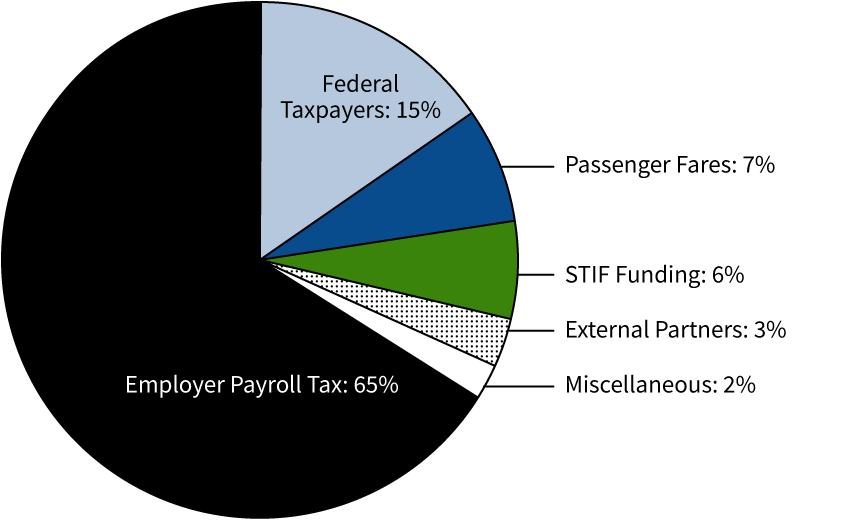
Employer Payroll Tax: 65%, Federal Taxpayers: 15%, Passenger Fares: 7%, STIF Funding: 6%, External Partners: 3%, Miscellaneous: 2%
How did we create our STIF plan for Fiscal Years 2028 and 2029?
TriMet is required to submit a plan to the Oregon Department of Transportation (ODOT) every two years for how we will use STIF funding in the tri-county area. To draft this plan, we used feedback from the public, which was collected in April 2026 during focus group sessions with registered and likely voters in Clackamas, Multnomah and Washington counties. Our goal was to learn how community members feel about TriMet funding and which of our programs are most important to support. The community told us that we should prioritize:
- Improved safety and security
- Maintenance of existing transit service
- Continuation of reduced fare programs
- Access to transit for students and youth
What is the plan for TriMet’s STIF funding in Fiscal Years 2028 and 2029?
ODOT estimates TriMet will receive about $136 million in STIF revenue in Fiscal Years 2028 and 2029. This is about 6% of all funding TriMet receives and is $14 million more than what will be received by the end of Fiscal Years 2026 and 2027. Due to inflation, rising gas prices and less money coming from fares due to Oregon’s high level of work from home, TriMet must use the growth in the STIF just to help prevent deeper cuts to bus service.
TriMet is planning to support the following programs with those funds:
- Fixed Route & LIFT Paratransit Operations (65% of funds): continue maintenance of existing bus and LIFT paratransit service throughout the TriMet service district.
- First/Last Mile Services & Coordination with Other Public Transportation Providers (12% of funds): continue to work with regional partners to provide first/last mile shuttle services in areas that can’t accommodate a standard bus and to increase coverage in outlying areas. Also, work with regional partners to make it easier to travel using a combination of TriMet and neighboring transit providers, as recommended by the STIF legislation.
- Subsidized Fare Programs (11% of funds): continue programs that reduce fares for riders with low incomes. This amount of funds will ensure TriMet has enough to meet the community’s needs during Fiscal Years 2028 and 2029.
- Portland Streetcar Service (4% of funds): to continue maintaining existing service, provide a share of funding to publicly-funded transit providers within the TriMet district, as suggested by the STIF legislation. Portland Streetcar is the only publicly funded transit provider within our district, owned by the City of Portland.
- LIFT Paratransit Vehicle Purchases (3% of funds): purchase new LIFT buses to replace aging vehicles.
- Contingency (3% of funds): maintain a 3% contingency to pay for unexpected cost increases or demand for reduced fares.
- Student Fare Program (1% of funds): continue the program providing free transit passes to students in grades 9–12 whose families earn low incomes. This amount of funds complies with the STIF legislation and will ensure TriMet has enough to meet the community’s needs during Fiscal Years 2028 and 2029.
- Program Administration (less than 1% of funds): support management of the STIF program in the tri-county area to make sure recipients receive allocated funds.
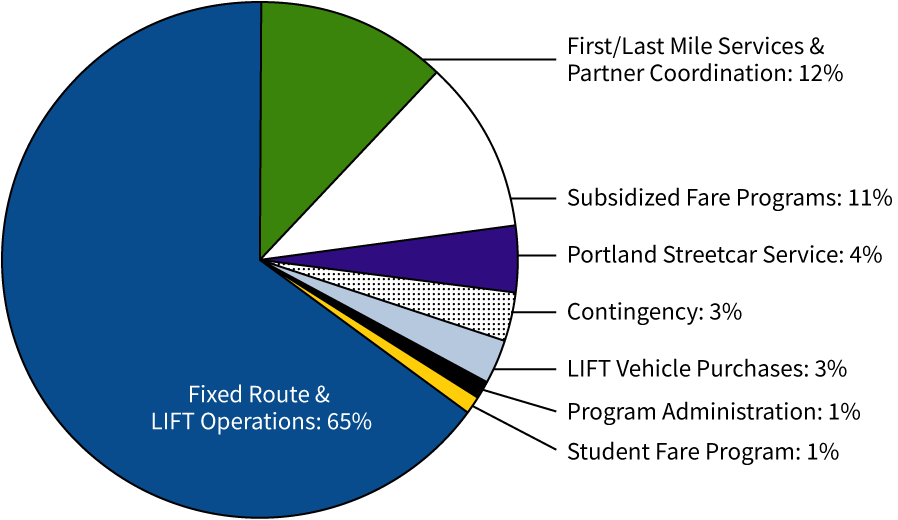
Fixed Route & LIFT Operations: 65%, First/Last Mile Services & Partner Coordination: 12%, Subsidized Fare Programs: 11%, Portland Streetcar Service: 4%, Contingency: 3%, LIFT Vehicle Purchases: 3%, Program Administration: 1%, Student Fare Program: 1%
Note: Safety and security programs are not included in the proposed TriMet STIF Plan for Fiscal Years 2028 and 2029 because they are funded by other sources.
Phản hồi
We want to know what you think about TriMet’s plan to spend STIF in Clackamas, Multnomah and Washington counties in Fiscal Years 2028 and 2029.